How to Build an Email List for a Small Business
Most small businesses pour everything into the top of the funnel — posts, ads, DMs, walk-ins — and then let those people evaporate because there’s no system to collect them. There’s a hole in the bucket. Here’s how to patch it, without a marketing team and without anything clever.

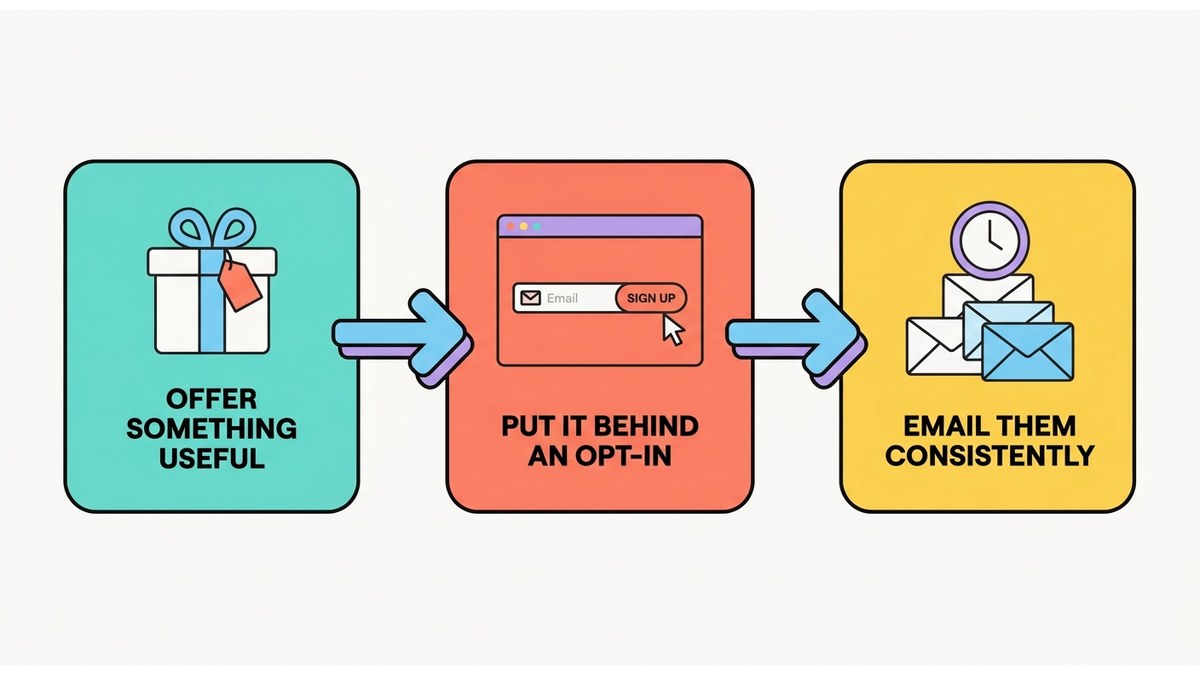
Building an email list for a small business takes three steps. Offer one genuinely useful thing that solves a specific problem. Put it behind an email opt-in on a page you control. Then email the people who take it, consistently. That’s it — the rest is just doing it. 🎯
In this article
- Why an email list beats followers
- Step 1: Offer one specific thing worth an email address
- Step 2: Put it behind an opt-in on a page you control
- Step 3: Get your first 100 subscribers
- What to send so they stay
- Mistakes that kill a small business list
- If you’d rather not build it yourself
- Frequently asked questions
Someone finds you. They like a couple of posts, or walk past your door, or read one page of your site. And then… nothing. Three weeks later they’ve forgotten you exist, and the next time they need what you sell they search from scratch and find someone else.
That’s the hole in the bucket, and it’s the most expensive thing I see in small businesses. Not bad marketing — unfinished marketing. The attention arrives and there’s nowhere for it to land.
An email list is the patch, and the fix is almost boringly reliable — which is why it works for a plumber, a pilates studio and a consultant equally well. 👇
Why an Email List Beats Followers
Because you own it. Social platforms are rented land: you build the audience, but the landlord decides who sees you and can change the rules tomorrow without telling you.
Organic reach on most platforms sits somewhere around 3–8% of your followers. So your 10,000 followers? Maybe 500 see a given post. On a good day. Now take a list of 500 subscribers with a 40–50% open rate — that’s 200–250 people actually reading, from a list a twentieth the size. And every one of them put up their hand and asked to hear from you.
That’s the whole argument. Social media is how people find you. Email is how they buy from you. A list of 50 engaged people is worth more than 10,000 passive followers, and it doesn’t evaporate when an algorithm has a bad week — something I’ve written about at length in how to reset your Instagram algorithm.
And it’s never too early. “I’ll start a list when I’ve got an audience” is backwards — start now and every visitor gets captured from day one instead of lost.
Step 1: Offer One Specific Thing Worth an Email Address
Nobody hands over their email for “updates.” They hand it over for one thing that solves one narrow problem they have right now — and the narrower it is, the better it converts.
This is where most small businesses go wrong. They build something broad — “The Ultimate Guide to Home Renovation” — because broad feels like it will appeal to more people. It appeals to nobody. A freebie that promises everything reads as a brochure; one that fixes a single annoying thing reads as a favour. So think smaller than feels comfortable:
- A bookkeeper: a one-page checklist of the expenses sole traders forget to claim.
- An electrician: “What it actually costs to rewire a three-bed house” — real numbers, no quote required.
- A pilates studio: a ten-minute routine for people who sit at a desk all day.
- A freelance designer: the brief template they use before starting any project.
- A business coach: the five questions to ask before hiring your first employee.
- A consultant: a short diagnostic that tells someone whether they have the problem they think they have.
Each of those is finishable in ten minutes, useful even if the person never buys, and quietly proves you know what you’re doing. That last part matters more than the download itself — the freebie is an audition.
One is enough. Building a second one is the most popular way to avoid doing step two. To go deeper, here’s our breakdown of freebies that actually get downloaded. ✅
Step 2: Put It Behind an Opt-In on a Page You Control
The freebie has to be locked behind an email opt-in on a page you own — not a social post, not a DM, not a Google Drive link you paste in comments. The page is where the exchange happens, and if you don’t control the page, you don’t control the exchange.
The page itself is a simple thing. A headline naming the problem, three lines on what they get, a name and email field, a button. No menu, no footer full of links, no “about us” — every extra option is a way out. And the button should say what happens next: “Send me the checklist” beats “Submit” every time.
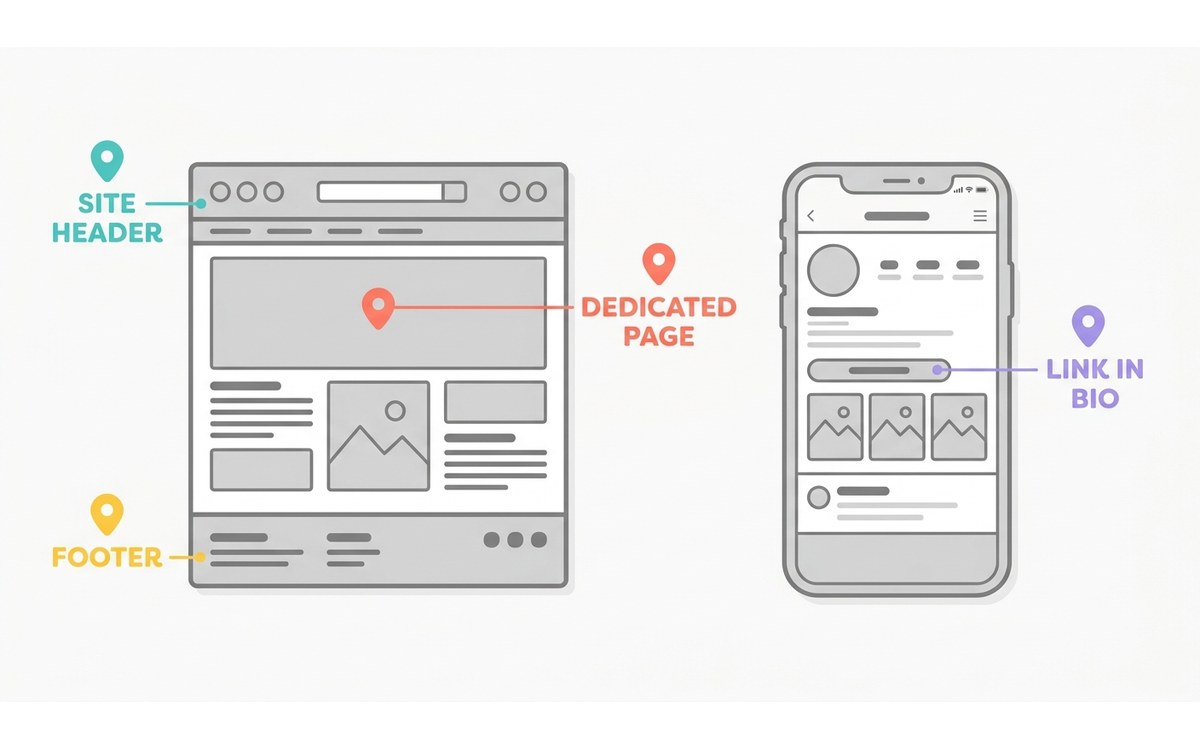
Then put the door in more than one wall. The same offer should appear everywhere someone might already be paying attention:
- The dedicated landing page — the one you link to from everywhere else.
- Your site header or a slim banner — visible on every page, one line, one link.
- Your footer — low-converting but free, and it catches the thorough readers.
- Inside your best-performing pages — whichever page already gets traffic deserves an opt-in halfway down.
- Your link in bio — the single most wasted piece of property in small business marketing.
- At the point of contact — the enquiry form, the booking confirmation, the counter, the invoice.
One rule that isn’t optional: only ever add people who asked. A business card at an event, or a paid invoice, isn’t consent to a newsletter. Ask, or put a tick box in front of them. Permission rules differ by country, so check what applies where you are — but the safe habit is universal, and it’s also just better marketing.
Step 3: Get Your First 100 Subscribers
Your first 100 subscribers almost never come from strangers. They come from people who already know you, plus a handful of unglamorous habits you set up once and leave running. Here’s what actually works — no growth hacking, no giveaways for iPads.
1. Tell the people who already know you
Past customers, current clients, anyone who enquired and went quiet. One short personal note: here’s the thing I made, here’s where to get it. That single email is usually worth your first thirty subscribers, and everyone skips it because it feels too easy.
2. Fix your link in bio
Point it at the landing page, not your homepage. People clicking a bio link are already curious, and a homepage gives them fourteen things to do instead of one. Change one URL, collect subscribers for years.
3. Add a line to your email signature
You already send dozens of emails a week to exactly the right people. One line under your name — what the freebie is, and the link. It costs nothing and it works quietly forever.
4. Make your content point somewhere
Whatever you already publish — posts, videos, articles — end it by pointing at the freebie. Not every time, but far more often than feels natural.
5. Partner with someone serving the same people
Find a business with your audience but not your offer — the accountant to your solicitor, the florist to your photographer. Mention each other’s freebies. Small, warm, and far better than shouting at strangers.
6. Show up where your community already gathers
A local business group, a trade association, a Facebook group for your town, a Slack for your industry. Be useful for weeks before you mention anything of your own. People join lists belonging to people they recognise.
7. Ask in person, at the point of sale
If you meet customers face to face, this is your biggest advantage over online-only businesses and almost nobody uses it. A card by the till with a QR code, or one sentence at checkout. The moment someone has just bought is the warmest you’ll ever get.
8. Guest on podcasts and other people’s newsletters
You don’t need big shows. A niche podcast with 400 committed listeners in your exact market beats a general one with 40,000. Borrow someone’s trust for half an hour, and send them somewhere specific afterwards.
9. Answer questions in public
Wherever your customers ask things — forums, groups, community threads — answer properly, with no pitch. Do it often enough and people go looking for you. Slow, and it compounds.
10. Put a simple banner on your site
One line across the top of every page offering the freebie. Not a pop-up that ambushes people in the first two seconds — a permanent, visible door. Your site already has visitors; most are leaving without a trace.
Do six of these ten and 100 subscribers is a matter of months, not luck. ⚠️ Just don’t let the number become the goal — engaged people who open things beat a big list that ignores you.
What to Send So They Stay
Send a short run of welcome emails immediately after someone subscribes, then settle into a regular rhythm. Weekly is the sweet spot. The rhythm matters more than the brilliance of any individual email.
Welcome emails do the heavy lifting, because that’s the window where you’re most interesting to a new subscriber — they just chose you. Five or six is plenty: deliver the freebie, say who you help, share something genuinely useful, and only then explain what working with you looks like. Here are welcome email examples for each one. Set them up once and they run forever.
Then keep showing up. And here’s the part I’ll be blunt about: the fear of annoying your subscribers is costing you far more than any email ever will. Almost nobody is emailing their list too much. Nearly everybody is emailing it too little. What I see in the accounts I look at is that the damage comes from silence, not frequency — people forget who you are, then mark you as spam when you reappear after four months.
What goes in the weekly email? Something you’d say to a good customer over coffee. The mistake you keep seeing, the question you’ve answered three times this month, a job you’re proud of. If you’re stuck, here are 35 newsletter ideas in seven repeatable angles — and how it all fits together in a simple funnel. 📩
Mistakes That Kill a Small Business List
Six ways I watch small businesses waste a perfectly good list. All avoidable, and most of them things people do because they seem sensible.
Buying a list
Don’t. Bought lists are people who never asked to hear from you, which means complaints, which wrecks your sender reputation and takes the emails your real subscribers wanted down with it. Permission rules differ by country, so check what applies to you — but commercially it’s a bad deal regardless. If cold outreach is what you’re really considering, read our honest take on whether cold email works first.
Making “join my newsletter” the offer
That’s asking for something and offering nothing. Nobody wakes up wanting more newsletters. Offer the specific useful thing and let the newsletter be what happens next.
Collecting emails with nowhere to send them
A spreadsheet of addresses is not a list. With no welcome emails and no rhythm behind the form, you’re collecting names you’ll be too embarrassed to email six months from now.
Going quiet for months
Three emails in a good week, nothing until the next slow season, then a desperate promotion. Subscribers don’t remember signing up, and it lands like a stranger asking for money.
Broadcasting instead of talking
Announcements, offers, company news. Nobody subscribed to a press release. Write to one person about something they’re dealing with, and let the selling be roughly one email in five.
Ignoring the people who reply
Replies are the most valuable thing your list produces, and they’re routinely dumped in a no-reply inbox. Send from a real address and answer every one — what people ask is your next six emails and often your next customer.
If You’d Rather Not Build It Yourself
Everything above works whether or not you ever pay anyone. The tools are cheap, the steps are public, and plenty of small businesses run this themselves for years.
The honest failure point isn’t knowledge — it’s week seven. You’re busy doing the actual work, the email doesn’t get written, and then it doesn’t get written again. That’s the gap Nautilus’s done-for-you email marketing exists to fill: we build the freebie, the landing page, the welcome emails and the weekly newsletter in your voice, with deliverability and the technical setup handled. You review and approve — nothing goes out that you haven’t seen, and we only ever email people who asked to hear from you.
I’ll be straight about fit: we specialise in coaches, consultants and solo experts — businesses that sell expertise, where trust builds over months. If you’re an e-commerce shop needing abandoned-cart automations, we’re not the right people. One flat plan at $199 a month, no trial and no free tier, with a 30-day money-back guarantee on your first month — all on the pricing page. The comparison worth making is the $500–$5,000 a month an agency quotes for the same scope.
Not sure what your list should be doing for your business? Answer a few questions about what you do and your free custom roadmap will map it out — the freebie, where the opt-ins go, the welcome emails, and the rhythm that keeps you in mind until people are ready to buy.
Claim my roadmapFree · No credit card · 3 minutes
Either way, do one thing before you close this tab: decide what your one freebie is. Not build it — decide it. Everything else in this article follows from that single sentence. 🎯
Entrepreneur | Co-founder @ Nautilus, the done-for-you email marketing service for coaches & consultants. I write about email marketing, funnels, lead generation and everything I learned during the past 15 years building businesses, writing software and generating leads in the digital world.
Frequently Asked Questions
How do I start an email list from scratch?
Pick one specific problem your customers have and make one genuinely useful thing that solves it — a checklist, a short guide, a real price breakdown. Put it behind an email opt-in on a page you control, then tell the people who already know you: past customers, current clients, anyone who enquired and went quiet. Add the link to your email signature and your link in bio. That is a working email list on day one. You do not need an audience first, and you do not need a marketing team — you need the offer, the page, and the habit of emailing the people who take it.
How many email subscribers does a small business need?
Far fewer than you would guess. A list of 50 engaged people who asked to hear from you is worth more than 10,000 passive followers, because with email there is no algorithm deciding who gets to see you. For most small businesses selling a considered service, a few hundred right-fit subscribers is a genuinely productive list. Chase engagement rather than size — a small list that opens and replies will do more for your business than a large one that ignores you, and it costs less to run.
What’s a good freebie for a small business?
One that solves a single narrow problem in about ten minutes. A bookkeeper offers a checklist of expenses sole traders forget to claim. An electrician publishes what a rewire actually costs. A studio gives a ten-minute routine for people who sit all day. A consultant offers a short diagnostic. The test is simple: could someone use it tonight and get a small, real result? Broad guides feel more impressive and convert far worse, because a promise to help with everything reads as a brochure while a promise to fix one specific annoyance reads as a favour.
Is it ever OK to buy an email list?
No. Bought lists are made of people who never asked to hear from you, so they complain or mark you as spam, and that damages your sender reputation — which means the emails your real subscribers actually wanted stop arriving too. You end up paying to make your own marketing worse. Permission rules also differ from country to country, so check what applies where you are before you email anyone. Building slowly with people who opted in is not just the safer route, it is the one that produces customers.
How often should a small business email its list?
Weekly is the sweet spot, with a short run of welcome emails when someone first joins. The fear of annoying your subscribers costs most small businesses far more than any email ever will — almost nobody is emailing their list too much, and nearly everybody is emailing it too little. Every two weeks is a fine second choice if weekly is not sustainable. What does real damage is silence: go quiet for four months and people forget who you are, so your next email lands like a stranger asking for money.
Patch the Hole in the Bucket
Stop letting the people who find you evaporate. Get your free custom roadmap and see exactly what your email list should look like — the freebie, the opt-ins, the welcome emails and the weekly rhythm.
Claim my roadmapNo credit card · 3 minutes